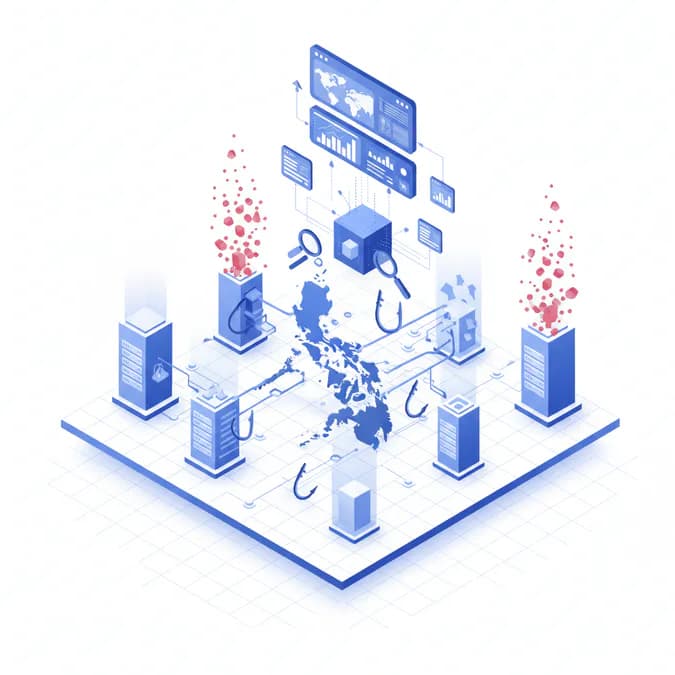
Cybersecurity threats in the Philippines reached critical levels in 2025, with phishing Philippines 2025 activity surging more than fourfold according to recent threat intelligence reports. This dramatic 423% increase in phishing sites represents one of the most significant cybersecurity challenges facing the nation, as criminal groups shift their tactics and expand their targeting capabilities across the region. Understanding this threat landscape is essential for organizations and individuals seeking to protect themselves from increasingly sophisticated attacks.
The scale of phishing Philippines 2025 incidents has created an unprecedented challenge for security professionals, law enforcement, and policymakers. Rather than deploying single phishing domains, attackers are now creating multiple malicious websites simultaneously, significantly increasing the probability that potential victims will encounter fraudulent sites. This distributed approach makes detection and takedown efforts considerably more challenging for security teams and law enforcement agencies.
The 423% Phishing Surge in the Philippines: Understanding the Crisis
The Philippines experienced an unprecedented surge in phishing activity during 2025, with phishing sites increasing by 423% according to Newsbytes.PH. This dramatic escalation reflects a deliberate shift by cybercriminal groups to target the Philippine mar

The scale of this increase is staggering when examined in detail. Rather than deploying single phishing domains, attackers are now creating multiple malicious websites simultaneously, significantly increasing the probability that potential victims will encounter fraudulent sites. This distributed approach makes detection and takedown efforts considerably more challenging for security teams and law enforcement.
The surge coincides with the Philippines' continued growth in digital adoption, e-commerce expansion, and increased reliance on online banking services. These developments, while beneficial for economic growth, have created an expanded attack surface that cybercriminals are actively exploiting. The timing of this phishing Philippines 2025 surge suggests coordinated efforts by criminal organizations to maximize their impact during a period of rapid digital transformation.
According to cybersecurity analysts, the 423% increase represents a fundamental shift in how criminal groups approach the Philippine market. Rather than opportunistic attacks, these campaigns demonstrate strategic planning and resource allocation. The sophistication of these attacks has increased proportionally with their volume, creating a compounding threat that requires immediate attention.
Understanding the Evolving Threat Landscape for Phishing Philippines 2025
The threat landscape in the Philippines has evolved significantly beyond basic phishing attempts. Criminal groups are now employing sophisticated techniques that make fraudulent websites nearly indistinguishable from legitimate ones:
Domain Spoofing: Attackers register domains that closely mimic legitimate business websites, using slight variations in spelling or structure to deceive users. These variations are often so subtle that even security-conscious individuals may not notice the difference at first glance.
SSL Certificate Abuse: Fraudulent sites increasingly use valid SSL certificates, displaying the green security indicator that users have been trained to trust. This exploitation of user trust in security indicators represents a significant evolution in phishing tactics.
Advanced Social Engineering: Phishing campaigns are becoming more personalized and contextually relevant, increasing their effectiveness. Attackers now research their targets extensively, incorporating specific details that make messages appear legitimate and urgent.
Multi-Sector Targeting: Attacks span banking, e-commerce, government services, and social media platforms. The breadth of targeting suggests that criminal organizations are casting wide nets while also conducting highly targeted campaigns against specific organizations.
Credential Harvesting at Scale: Modern phishing Philippines 2025 campaigns often employ sophisticated credential harvesting techniques that capture login information, payment details, and personal identification data simultaneously.
These sophisticated tactics exploit the gap between rapid digital adoption and security awareness in the Philippines. Many users and organizations lack the training necessary to identify these advanced phishing attempts. The combination of technical sophistication and social engineering creates a formidable threat that requires comprehensive defensive strategies.
Security researchers have noted that phishing Philippines 2025 campaigns often incorporate elements of spear-phishing, targeting specific individuals within organizations with messages tailored to their roles and responsibilities. This personalization significantly increases the likelihood of successful attacks.
Essential Protection Strategies Against Phishing Philippines 2025
Both organizations and individuals must implement comprehensive security measures to defend against the escalating phishing threat in the Philippines.
Organizational Defense Measures
Organizations must adopt a multi-layered approach to protect against phishing Philippines 2025 attacks:
Advanced Email Security Solutions: Deploy advanced email filtering and security solutions that detect phishing attempts before they reach users. These systems should incorporate machine learning algorithms that identify suspicious patterns and block malicious content automatically.
Multi-Factor Authentication Implementation: Implement multi-factor authentication across all critical systems and applications. This additional security layer significantly reduces the impact of compromised credentials, even when phishing attacks succeed in capturing login information.
Comprehensive Security Awareness Training: Conduct regular security awareness training focused on phishing recognition and reporting procedures. Employees should receive training at least quarterly, with additional sessions following significant phishing incidents or when new attack patterns emerge.
Incident Response Procedures: Establish incident response procedures specifically designed for phishing incidents. These procedures should include clear escalation paths, containment strategies, and communication protocols.
Threat Intelligence Monitoring: Monitor threat intelligence reports regularly to stay informed about emerging attack patterns. Subscribing to threat intelligence feeds specific to the Philippines can provide early warning of new phishing campaigns.
Regular Security Assessments: Perform regular security assessments and penetration testing to identify vulnerabilities. These assessments should specifically include phishing simulations to evaluate employee susceptibility to attacks.
Domain Monitoring Services: Implement domain monitoring services that alert organizations when domains similar to their own are registered. This proactive approach can help identify phishing sites targeting the organization before they become widely distributed.
Individual User Protection Strategies
Individual users must remain vigilant and implement personal security practices:
URL Verification: Verify URLs carefully before entering any credentials or sensitive information. Users should hover over links to see the actual destination and should be suspicious of URLs that don't match the organization they claim to represent.
Two-Factor Authentication: Enable two-factor authentication on all important accounts. This is particularly critical for email accounts, banking platforms, and social media accounts that could be used to compromise other accounts.
Password Management: Use password managers to avoid reusing credentials across multiple platforms. Password reuse is a significant vulnerability that allows attackers to compromise multiple accounts after a successful phishing attack.
Link Verification Practices: Hover over links to verify the actual destination before clicking. Users should be particularly suspicious of links in unsolicited emails, even if they appear to come from trusted sources.
Incident Reporting: Report suspicious emails to your organization's security team immediately. Prompt reporting allows security teams to investigate threats and prevent other employees from falling victim to the same attacks.
Software Updates: Keep software and operating systems updated with the latest security patches. Many phishing attacks exploit known vulnerabilities that could be prevented through timely updates.
Email Scrutiny: Examine sender addresses carefully, as attackers often use addresses that closely resemble legitimate ones. Look for subtle differences in spelling or domain names that might indicate a spoofed address.
Organizational and Government Response to Phishing Philippines 2025
The severity of the phishing surge has prompted increased attention from government agencies and industry organizations in the Philippines. Coordinated cybersecurity efforts are becoming essential to address this escalating threat.
Public-private partnerships and information sharing initiatives are critical components of an effective response. When organizations share threat intelligence about phishing campaigns, attack patterns, and malicious domains, the entire ecosystem becomes more resilient. Government agencies can work with private sector organizations to identify emerging threats and distribute actionable intelligence to vulnerable organizations.
The Philippine National Police's Anti-Cybercrime Group and the National Bureau of Investigation have increased their focus on phishing Philippines 2025 investigations. These law enforcement agencies are working to identify and prosecute cybercriminals responsible for large-scale phishing campaigns.
Industry-specific security standards and best practices are also being developed to address sector-specific phishing threats. Banking institutions, e-commerce platforms, and government agencies are implementing enhanced security measures tailored to their unique threat profiles.
The Bangko Sentral ng Pilipinas (BSP) has issued guidance to financial institutions regarding phishing threats and required security measures. These regulatory requirements are driving increased investment in security infrastructure across the banking sector.
Cybersecurity organizations in the Philippines are also playing a crucial role in coordinating response efforts. Industry associations are facilitating information sharing and best practice dissemination among member organizations.
Sector-Specific Phishing Philippines 2025 Threats
Banking and Financial Services
The banking sector faces particularly sophisticated phishing Philippines 2025 attacks targeting both customers and employees. Attackers create convincing replicas of banking websites and mobile applications, capturing login credentials and two-factor authentication codes.
Financial institutions are responding by implementing advanced fraud detection systems, enhanced customer verification procedures, and increased security awareness training for employees.
E-Commerce Platforms
E-commerce companies are experiencing phishing attacks targeting both customers and sellers. These attacks often impersonate payment processors or marketplace administrators, attempting to capture payment information or seller credentials.
E-commerce platforms are implementing additional verification steps for sensitive transactions and providing enhanced security tools for seller accounts.
Government Services
Government agencies are also targets of phishing Philippines 2025 campaigns. These attacks often impersonate government services to capture personal identification information or to compromise government employee accounts.
Government agencies are implementing enhanced security measures and conducting security awareness training for employees who handle sensitive citizen information.
Frequently Asked Questions About Phishing Philippines 2025
Q: What is the primary reason for the 423% increase in phishing sites in the Philippines?
A: The surge is driven by the Philippines' rapid digital transformation, growing e-commerce market, and increased online banking adoption. Cybercriminals are capitalizing on this expanded attack surface and exploiting security awareness gaps among users and organizations.
Q: How can I identify a phishing email?
A: Look for several warning signs: sender addresses that don't match the organization they claim to represent, urgent language requesting immediate action, requests for sensitive information, poor grammar or spelling, suspicious links or attachments, and generic greetings instead of your name. Hover over links to verify the actual destination before clicking.
Q: What should I do if I've already clicked on a phishing link?
A: If you clicked a link but didn't enter any information, the risk is minimal. If you entered credentials or personal information, immediately change your passwords, enable two-factor authentication if not already enabled, and contact your bank or the relevant organization. Monitor your accounts for suspicious activity and consider placing a fraud alert with credit bureaus.
Q: Are small businesses at risk from phishing Philippines 2025 attacks?
A: Yes, small businesses are frequently targeted because they often have fewer security resources than larger organizations. Attackers may target small business employees to gain access to customer data or financial systems. Small businesses should implement basic security measures including email filtering, multi-factor authentication, and employee training.
Q: How effective is security awareness training against phishing attacks?
A: Security awareness training is highly effective when conducted regularly and reinforced with phishing simulations. Studies show that organizations with comprehensive training programs experience significantly fewer successful phishing attacks. Training should be ongoing, not a one-time event.
Q: What role do government agencies play in combating phishing Philippines 2025?
A: Government agencies investigate phishing crimes, coordinate with international law enforcement, issue security guidance to organizations, and work with internet service providers to block malicious domains. The Philippine National Police's Anti-Cybercrime Group is actively investigating phishing campaigns.
Q: Can I trust websites with SSL certificates?
A: While SSL certificates indicate encrypted communication, they don't guarantee legitimacy. Phishing sites increasingly use valid SSL certificates. Always verify the domain name carefully and look for other indicators of legitimacy beyond the security indicator.
Q: What is two-factor authentication and why is it important?
A: Two-factor authentication requires two forms of verification to access an account, typically something you know (password) and something you have (phone or authentication app). It's important because even if attackers obtain your password through phishing, they cannot access your account without the second factor.
Key Takeaways
The 423% increase in phishing sites targeting the Philippines represents a critical escalation in cybersecurity threats that demands immediate attention from organizations and individuals alike. This surge reflects a deliberate shift by cybercriminal groups to exploit the nation's digital growth and capitalize on security awareness gaps.
Phishing Philippines 2025 campaigns have become increasingly sophisticated, employing advanced social engineering, domain spoofing, and credential harvesting techniques that make fraudulent sites nearly indistinguishable from legitimate ones. The multi-sector nature of these attacks means that virtually all organizations and individuals using online services are at risk.
Effective defense requires a multi-layered approach combining technical controls, security awareness training, and coordinated threat intelligence sharing. Organizations must prioritize email security, multi-factor authentication, and employee training, while individuals must remain vigilant about verifying URLs and protecting their credentials.
The threat landscape will continue to evolve, making ongoing security awareness and proactive threat monitoring essential for protecting against increasingly sophisticated phishing attacks. By understanding the scope of this threat and implementing comprehensive security strategies, organizations and individuals in the Philippines can significantly reduce their risk of falling victim to phishing campaigns.
Investment in security infrastructure, employee training, and threat intelligence capabilities will be critical for organizations seeking to protect themselves against phishing Philippines 2025 threats. Those who take proactive measures now will be better positioned to defend against future attacks as criminal tactics continue to evolve.