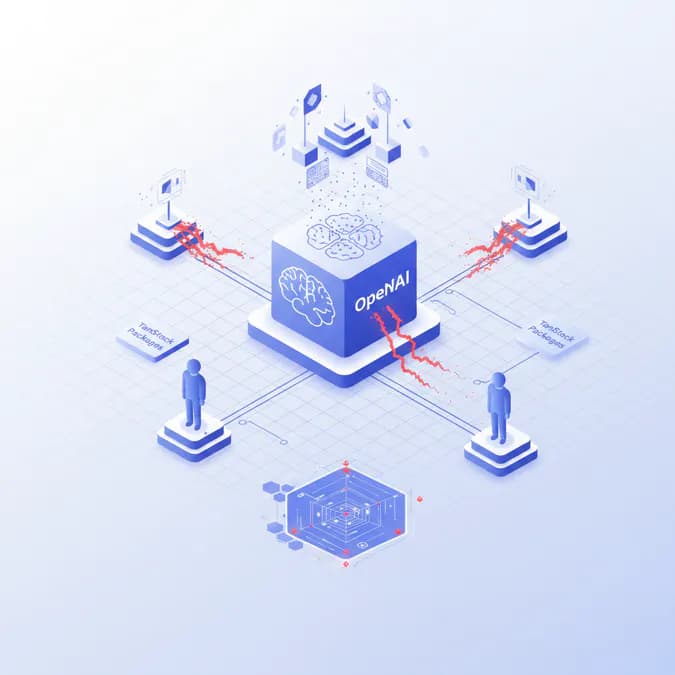
OpenAI recently confirmed it was targeted by a supply chain attack involving malicious TanStack packages, marking another significant incident in the growing wave of third-party dependency compromises affecting major technology organizations. The attack compromised two employee devices and exposed credential material from internal code repositories, though OpenAI's investigation found no impact to customer data, production systems, or intellectual property.
This incident underscores a critical vulnerability in modern software development: the reliance on open-source packages and automated build pipelines that, when compromised, can provide attackers direct access to downstream organizations. The TanStack compromise was part of a broader campaign called Mini Shai-Hulud that affected over 170 packages across npm and PyPI ecosystems, demonstrating how a single vulnerability in the supply chain can cascade across multiple organizations and projects.
Understanding the TanStack Supply Chain Attack
TanStack, a popular open-source library ecosystem, became the vector for a sophisticated attack that leveraged weaknesses in package publishing and GitHub Actions workflows. The attackers successfully inserted malicious code into trusted npm and

The attack was particularly insidious because it targeted the development tools and libraries that organizations depend on daily. Rather than attacking OpenAI directly, threat actors compromised upstream dependencies that OpenAI's developers used in their workflows. This approach is far more efficient for attackers, as a single compromised package can affect hundreds or thousands of downstream organizations simultaneously.
According to SecurityWeek, the attackers released 84 malicious artifacts across 42 packages during the TanStack compromise. This scale demonstrates the sophistication and coordination required to execute such an attack, as well as the significant reach these compromised packages achieved before detection.
How the Attack Compromised OpenAI
OpenAI's security team confirmed that two employee devices were compromised through the malicious TanStack packages. The attackers' primary objective was credential theft, and they succeeded in exfiltrating limited credential material from internal source code repositories.
In OpenAI's official response, the security team stated: "We observed activity consistent with the malware's publicly described behavior, including unauthorized access and credential-focused exfiltration activity, in a limited subset of internal source code repositories to which the two impacted employees had access." This statement reveals that the attackers followed a deliberate strategy focused on stealing authentication credentials rather than attempting broader system compromise.
The compromised credentials provided the attackers with limited access to OpenAI's internal repositories, but the company's investigation determined that the scope of exposure was contained. OpenAI confirmed: "We confirmed that only limited credential material was successfully exfiltrated from these code repositories and that no other information or code was impacted."
Critically, OpenAI emphasized that "We have found no evidence of compromise or risk to existing software installations," indicating that the attack did not result in backdoors or persistent access mechanisms being installed in production systems or customer-facing software.
The Broader Mini Shai-Hulud Campaign
The TanStack incident was not an isolated event but rather part of a coordinated campaign researchers designated as Mini Shai-Hulud. This broader campaign affected over 170 packages across npm and PyPI ecosystems, making it one of the most extensive supply chain compromise operations documented to date.
The scale of the Mini Shai-Hulud campaign demonstrates how supply chain attacks have evolved from targeting individual packages to orchestrating coordinated compromises across multiple ecosystems and namespaces. By spreading malicious artifacts across numerous packages, attackers increase the likelihood that at least some will be installed by high-value targets like OpenAI.
This campaign highlights a fundamental challenge in modern software security: the difficulty of maintaining visibility and control over the entire dependency tree. Organizations often have hundreds or thousands of direct and transitive dependencies, making it nearly impossible to manually audit each package for malicious code.
Attack Vector Analysis: Exploiting CI/CD Weaknesses
According to TanStack's own post-mortem analysis, the attackers exploited weaknesses in GitHub Actions workflows and CI/CD pipeline configurations. Specifically, they abused package publishing mechanisms to inject malicious code into the normal release pipeline, making the compromised packages appear legitimate to downstream consumers.
This attack vector is particularly effective because it leverages the trust that developers place in automated build and deployment systems. When a package is published through official channels using standard workflows, developers assume it has undergone appropriate security checks and review processes. By compromising the CI/CD infrastructure itself, attackers can bypass many traditional security controls.
The attack demonstrates several critical vulnerabilities in typical development workflows:
- Insufficient access controls on package publishing credentials
- Lack of code signing and verification for package releases
- Limited monitoring and alerting for unusual publishing activity
- Inadequate secrets management in CI/CD environments
- Insufficient review processes for automated package updates
OpenAI's Response and Remediation Measures
Following discovery of the compromise, OpenAI implemented a comprehensive remediation strategy that addressed both immediate containment and longer-term security hardening.
The company's response included:
- Credential rotation: All potentially exposed credentials were rotated to prevent further unauthorized access
- Session revocation: Active sessions associated with the compromised employee devices were terminated
- Deployment restrictions: Temporary restrictions were placed on deployments to prevent any malicious code from reaching production
- Code-signing certificate review: OpenAI reviewed and rotated code-signing certificates to ensure no backdoors were introduced
It's worth noting that this incident occurred during an ongoing security hardening effort that followed an earlier supply chain attack involving Axios-related signing and notarization materials. This suggests OpenAI had already begun implementing more rigorous controls over its software supply chain before the TanStack incident occurred.
Lessons for Enterprise Security and Dependency Management
The OpenAI incident provides several important lessons for organizations managing complex software supply chains:
Supply Chain Attacks Require New Threat Models
Supply chain attacks represent a fundamental shift in threat modeling. Rather than focusing exclusively on perimeter defense and endpoint protection, organizations must now treat dependency integrity as a core security priority. This requires visibility into all direct and transitive dependencies, regular audits of package sources, and mechanisms to detect and respond to compromised packages.
No Organization Is Immune
The incident demonstrates that even organizations with sophisticated security programs can be affected by supply chain compromises. OpenAI's security team is among the most capable in the industry, yet they were still targeted and partially compromised. This underscores that supply chain attacks are not a problem that can be solved through security awareness training or traditional endpoint protection alone.
Least-Privilege Access Limits Damage
The attack highlights the importance of least-privilege access and credential management. While the attackers gained access to internal repositories, the impact was limited because the compromised employees' credentials had restricted permissions. Organizations should implement fine-grained access controls that limit the blast radius of any individual credential compromise.
Protecting Against Supply Chain Attacks
Organizations can implement several strategies to reduce their vulnerability to supply chain attacks:
1. Dependency Scanning and Monitoring
Implement tools that continuously scan dependencies for known vulnerabilities and suspicious activity. Services like Snyk, Dependabot, and WhiteSource provide automated detection of compromised packages. These tools can alert security teams when a dependency has been flagged as malicious or when unusual publishing activity is detected.
2. Software Bill of Materials (SBOM)
Maintain detailed SBOMs for all applications, enabling rapid identification of which systems are affected by a compromised dependency. An SBOM provides a complete inventory of all components, libraries, and dependencies used in an application, making it possible to quickly determine exposure when a vulnerability is discovered.
3. Code Signing and Verification
Require cryptographic signatures on all package releases and verify signatures before installation. This makes it harder for attackers to distribute malicious packages without detection. Organizations should establish a process for verifying package signatures and rejecting unsigned or incorrectly signed packages.
4. Secrets Management
Use dedicated secrets management solutions rather than storing credentials in code or environment variables. Tools like HashiCorp Vault, AWS Secrets Manager, and Azure Key Vault provide centralized credential management with audit trails. This approach limits the exposure of credentials if a developer device is compromised.
5. CI/CD Hardening
Implement strict access controls on CI/CD systems, require multi-factor authentication for publishing packages, and monitor for unusual publishing activity. CI/CD systems are high-value targets for attackers because they control the software release pipeline. Hardening these systems should be a top priority.
6. Network Segmentation
Isolate development environments from production systems to limit the impact of compromised developer devices. If a developer device is compromised, network segmentation ensures that attackers cannot directly access production systems or sensitive infrastructure.
7. Incident Response Planning
Develop and regularly test incident response procedures specifically for supply chain compromises, including processes for rapid credential rotation and deployment rollback. Organizations should have a documented playbook for responding to supply chain incidents, including communication procedures, containment steps, and recovery processes.
The Bottom Line
The OpenAI supply chain attack involving malicious TanStack packages represents a critical reminder that modern software security extends far beyond an organization's own infrastructure. The attack compromised two employee devices and exposed credential material, but OpenAI's rapid response and existing security controls prevented broader impact to customer data and production systems.
As software development becomes increasingly dependent on open-source packages and automated build pipelines, supply chain security must become a central focus for enterprise security teams. Organizations should treat dependency integrity, build-system hardening, and credential management as core security priorities rather than afterthoughts. The Mini Shai-Hulud campaign and similar incidents will likely continue as attackers recognize the efficiency of targeting upstream dependencies rather than individual organizations.
By implementing comprehensive dependency monitoring, code signing verification, secrets management, and CI/CD hardening, organizations can significantly reduce their exposure to supply chain attacks. However, complete elimination of this risk is impossible in today's interconnected software ecosystem. The goal should be to detect and respond to compromises as quickly as possible, minimizing the window of opportunity for attackers to cause damage.
Sources
- Automated Pipeline
- Our response to the TanStack npm supply chain attack
- OpenAI hit by TanStack supply chain attack
- OpenAI confirms security breach in TanStack supply chain attack
- TanStack official website
- TanStack GitHub organization
- Source: betterworldtechnology.com
- Source: binance.com
- Source: theregister.com